„Dimitrie Cupovski“ 13, 1000 Skopje +38923244000 ic@mchamber.mk
„Dimitrie Cupovski“ 13, 1000 Skopje +38923244000 ic@mchamber.mk
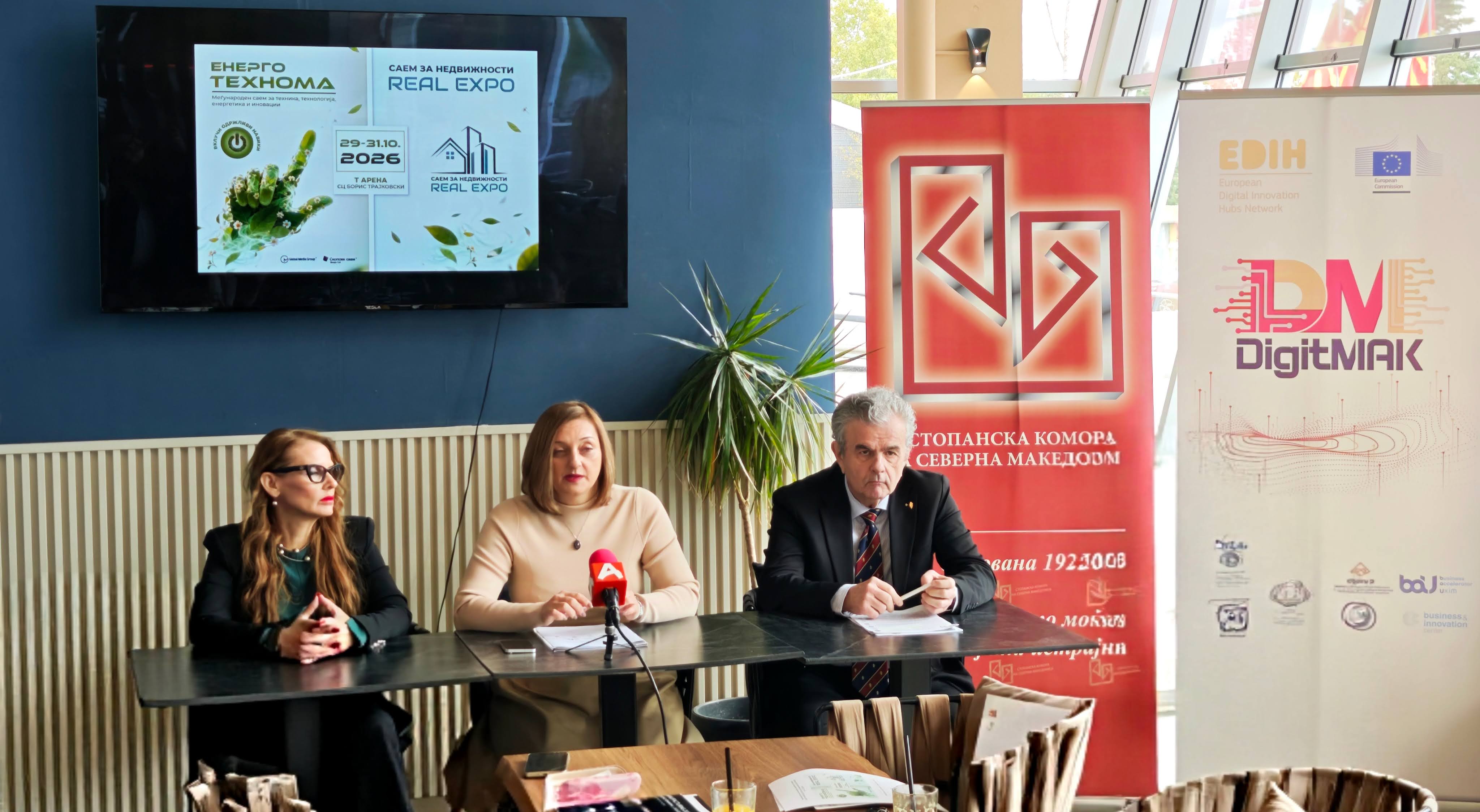
As part of the upcoming International Fair for Technology, Energy, and Innovation – ENERGO TEHNOMA 2026, scheduled from 29 to 31 October 2026 at the Boris Trajkovski Arena (T-Arena) in Skopje (held concurrently with Real Expo), a leading industrial conference "Manufacturing 2026: Transformation Towards Innovation" will take place on 30 October 2026. The conference is organized in partnership among the Macedonian Association of Metal and Electrical Industry (MAMEI), the Economic Chamber of North Macedonia, and the European Digital Innovation Hub – DigitMak.
At the press briefing, Daniela Gligorovska, Executive Director of Skopje Fair, and Marta Naumovska-Grnarova, President of the Macedonian Association of Metal and Electrical Industry (MAMEI), emphasized their long-standing collaboration and the significance of the event as a core business platform for promoting emerging technologies, business networking, and reinforcing the export positions of the domestic economy. For his part, Antoni Peshev, Executive Director of the Economic Chamber, stressed that the Chamber centers its focus on the imperative of connecting industrial entities with the knowledge, state-of-the-art technologies, and partnerships required for companies to remain competitive, efficient, and prepared for the new industrial reality.
Peshev underscored that the future of domestic manufacturing depends on the capacity of enterprises to transform technology and innovation into higher productivity, greater added value, and stronger export competitiveness across European markets. As he pointed out, digitalization must not remain merely a declaratory commitment or a basic capital expenditure in hardware and software, but rather a process that generates measurable business results, reduced operational overhead, and enhanced decision-making—a challenge that is particularly pronounced for small and medium-sized enterprises lacking in-house digital transformation teams.
One of the conference panel discussions will be dedicated to examining how Macedonian enterprises can expand exports and sustain their competitiveness within the European market, focusing on enhancing export capabilities and securing better positioning for domestic manufacturers across international value chains. "Export competitiveness does not depend solely on production capacities, but also on the agility of enterprises to comply with emerging standards, regulatory requirements, and the expectations of European buyers. In this context, exports constitute one of the core priorities within the Economic Chamber's portfolio of activities. Through the Exporters’ Club and the National Export Council, as well as via an extensive array of services and support mechanisms, the Chamber consistently works to advance export prospects for companies, placing dedicated focus on the metal and electrical engineering industries," Peshev noted.
A central element of DigitMak and the Chamber's participation in the conference is the international panel discussion titled "Manufacturing 4.0: How EDIHs Can Accelerate Transformation." This session tackles the practical challenges faced by manufacturers through the presentation of regional case studies and specific support instruments provided by DigitMak:
· Test Before Invest: Validation and testing of advanced digital solutions and artificial intelligence prior to committing significant capital investments, thereby substantially mitigating financial risk for enterprises;
· Digital Maturity Assessment: Comprehensive analysis of organizational capabilities for seamless integration into modern manufacturing value chains;
· Skills Development and Smart Investment: Upskilling workforce to meet emerging industrial standards and facilitating access to appropriate funding sources.
Through these initiatives, the objective is to ensure that Macedonian manufacturing companies do not remain passive observers of industry shifts, but act as proactive stakeholders fully prepared to meet the stringent demands of the EU market.

 Progressive Academy